
Original research
We Ran the Same 45 AI Searches Twice. Here's Who the Engines Actually Recommend.
July 2026. Fifteen U.S. cities, three questions a real homeowner would ask, on ChatGPT, Google AI Mode, and Perplexity — and then the identical set again in a clean incognito session, 90 searches in total. Who gets recommended, does it hold up across engines and sessions, and what evidence do the AIs actually cite?
By Collin Fugate, Skygain · Data collected July 8, 2026 · ~7 min read
Methodology
We picked 15 cities (Austin, Denver, Tampa, Phoenix, Charlotte, Columbus, Portland, Nashville, San Diego, Pittsburgh, Kansas City, Raleigh, Tucson, Cleveland, Jacksonville) and rotated three questions a real homeowner would actually ask:
- "I have a burst pipe and need an emergency plumber in [city]. Who should I call?"
- "My water heater died and I need it replaced this week in [city]. Which plumber should I use?"
- "Who's the best plumber in [city] for a clogged main drain?"
Every question named a specific city. We ran each one on ChatGPT (web, logged out, default model), Google AI Mode, and Perplexity (web, logged out, default model), all on July 8, 2026, then ran the identical set a second time the same day in a fresh incognito session, logged out of everything: 90 searches in total. The two conditions let us separate what's driven by personalization from what's simply the probabilistic nature of these models. For every answer we logged each business the engine named and every source it cited as evidence. One cell (Portland / Perplexity, round one) returned a sign-up wall instead of results and is marked as missing below rather than guessed.
Finding 1: the engines almost never agree
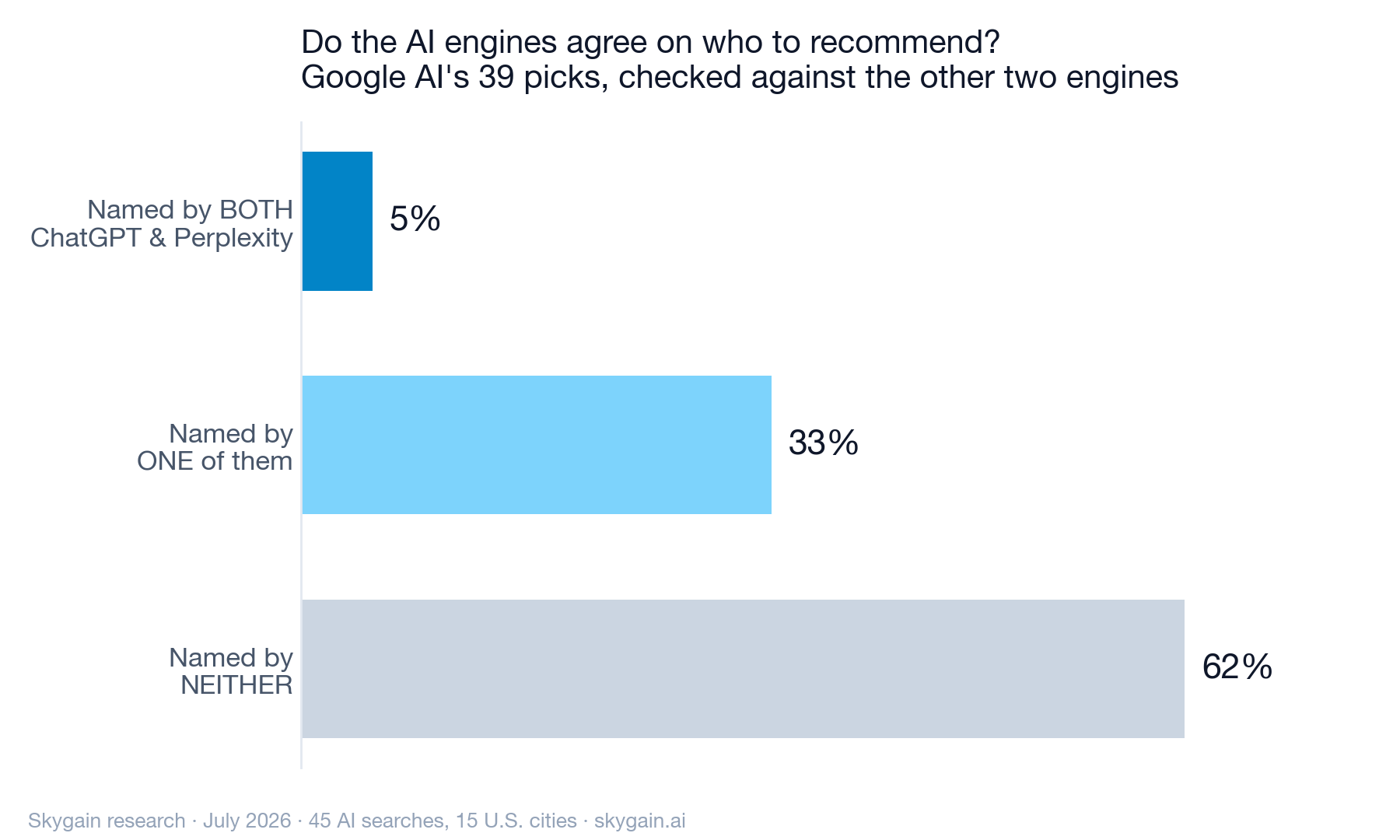
Of the 39 businesses Google's AI recommended across the 15 cities, only 2 were also named by both ChatGPT and Perplexity for the same question. 62% weren't named by either one. In Tampa, the three engines produced three completely different sets of winners with barely a name in common.
The practical meaning for a local business: which AI your customer happens to use decides whether you exist. Being visible on one engine says almost nothing about the other two.
Finding 2: answers shift even between identical runs
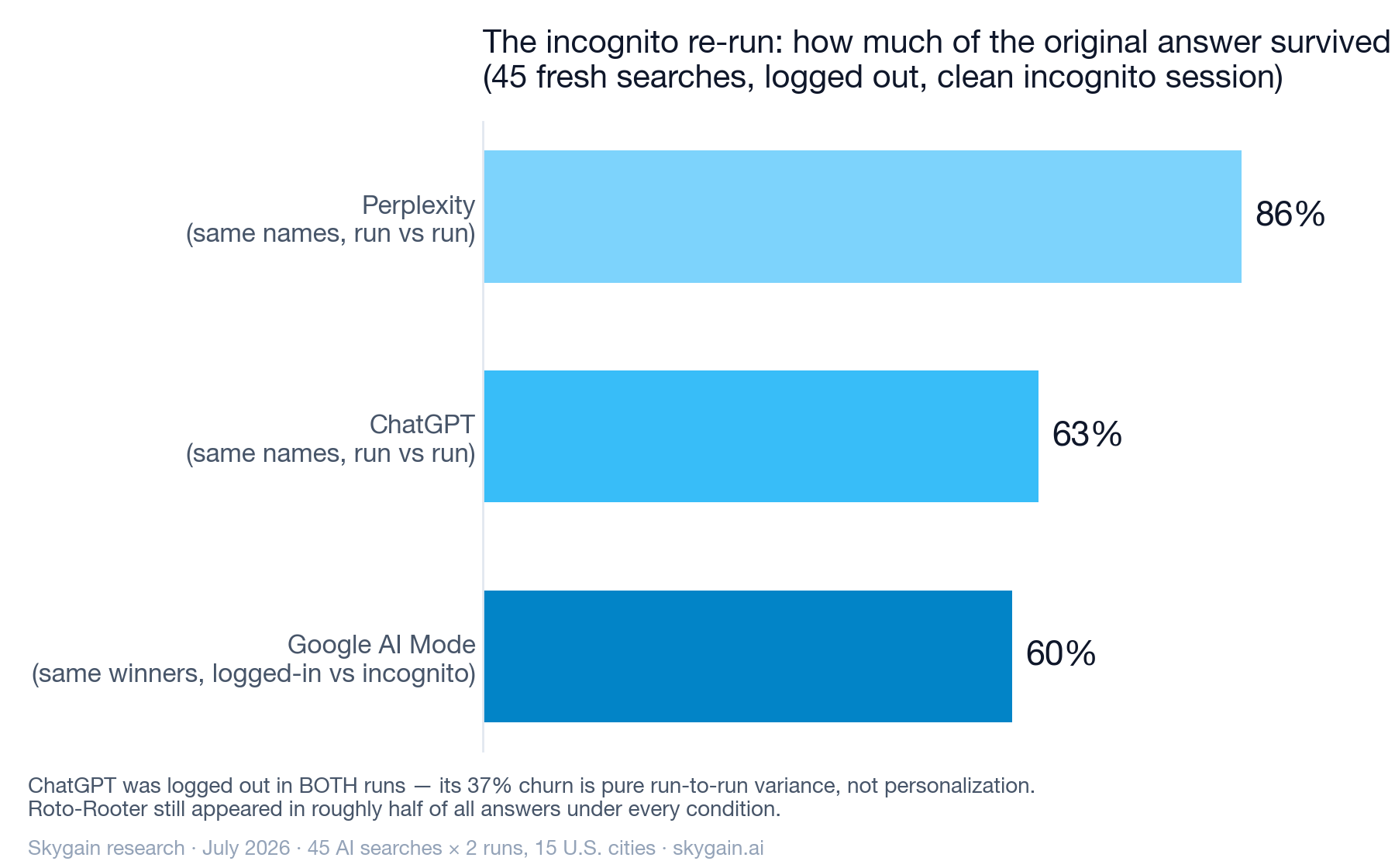
Running the same searches a second time in a clean session showed how much answers move on their own. On Google AI Mode, about 60% of cities returned the same winners in incognito; the rest flipped to different companies, so personalization is real, but it isn't most of the picture. ChatGPT was logged out in both conditions and still repeated only about two thirds of its business names between runs: that churn isn't personalization at all, it's the probabilistic nature of the models. Perplexity was the most deterministic at roughly 85%.
Finding 3: the one kind of business that survives everything
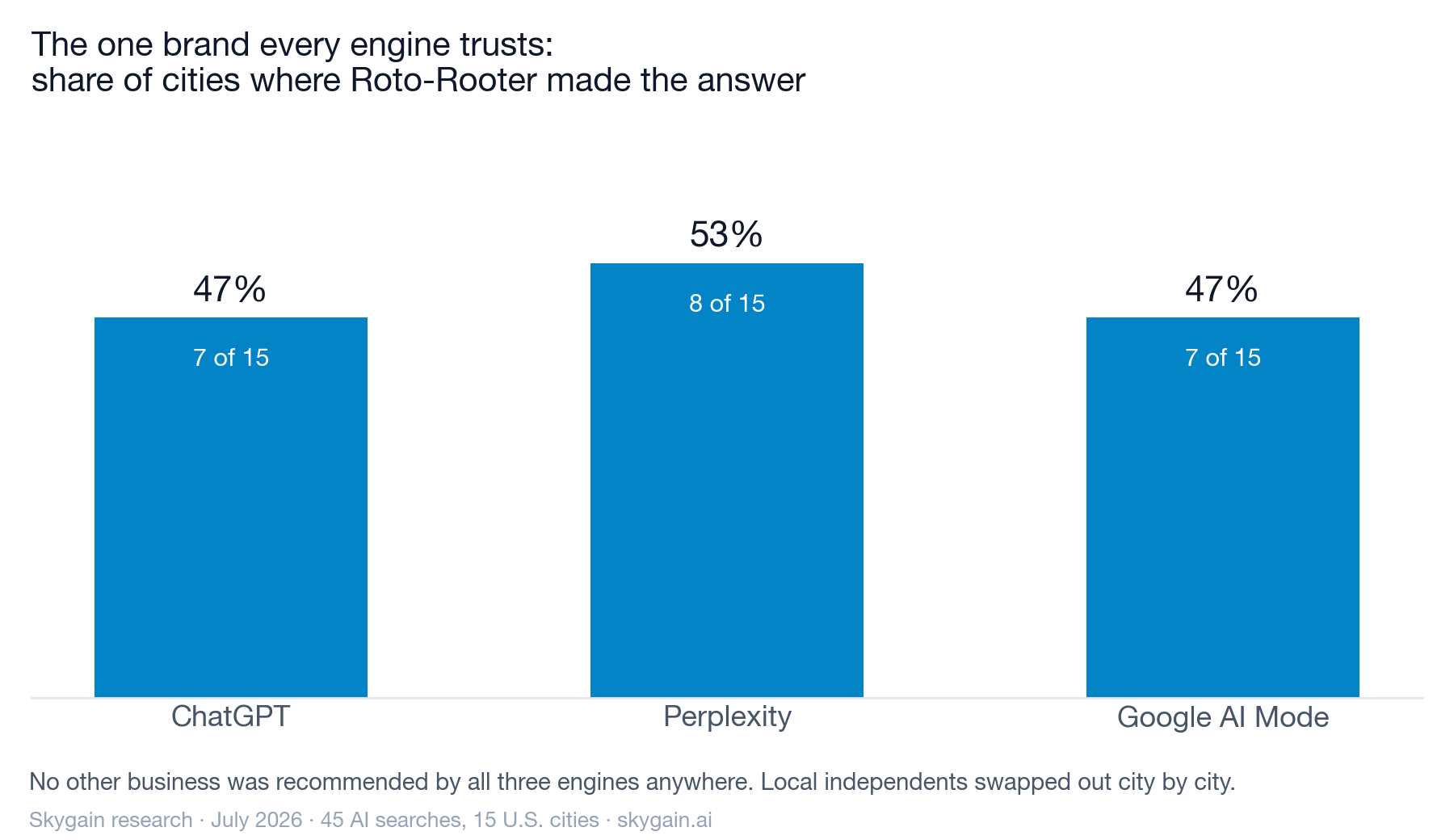
One name appeared in roughly half of all answers across all three engines, in both conditions: Roto-Rooter. Not because any one branch is exceptional, but because every branch inherits a national footprint: a huge domain, review pages in every metro, and directory listings everywhere the engines look. Franchise scale is pre-built corroboration, and it was the only thing in the entire dataset that held up across engines, sessions, and the models' own randomness.
Finding 4: the evidence lives off your website
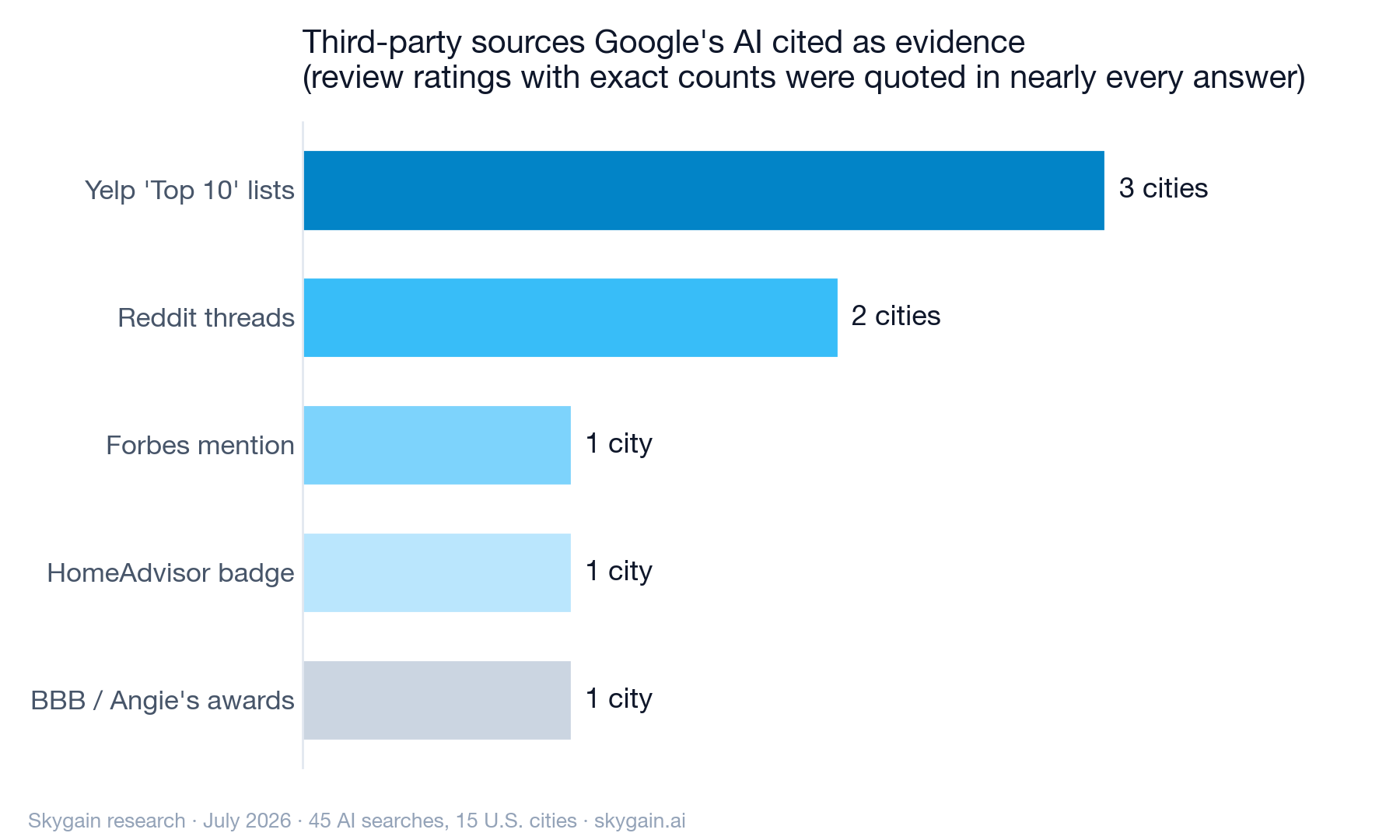
The receipts the engines cited when picking winners: Yelp "Top 10" lists in three different cities, Reddit threads (r/Columbus, r/Cleveland, and r/kansascity across the two runs), a local Facebook group, a Forbes mention, a HomeAdvisor "Top Rated" badge, BBB ratings, Angie's List awards, and review counts quoted with specific numbers in nearly every answer. The business's own website appeared mostly as confirmation, almost never as the reason.
Finding 5: the reasoning is hyper-local now
Google's AI justified Denver picks by altitude affecting combustion on gas water heaters, and Nashville picks by limestone geology causing sediment buildup. The engines are reading local context more deeply than most local businesses are writing it.
Appendix: the city-by-city results
Top recommendations per engine from round one (first two businesses each engine named). Round two (incognito) shifted the cells discussed in Finding 2; the full raw logs are available on request.
| City | Question | ChatGPT | Perplexity | Google AI Mode |
|---|---|---|---|---|
| Austin, TX | Burst pipe | Abacus Plumbing; Daniel's Plumbing & Air | Economy Plumbing; Clarke Kent Plumbing | Reliant Plumbing; ABC Home & Commercial |
| Denver, CO | Water heater | Euro Plumbing; Water Heater Experts | Heart Heating; Time Plumbing | EZ Repair; Brothers Plumbing |
| Tampa, FL | Main drain | Premium Plumbing; Matt's Plumbing | Believe Plumbing; Olin Plumbing | EVERYDAYPLUMBER.com; The Clean Plumbers |
| Phoenix, AZ | Burst pipe | Pink Plumbing & Sewer; Wyman Plumbing | Elite Rooter; Royal Rooter | George Brazil; Roto-Rooter of Phoenix |
| Charlotte, NC | Water heater | Charlotte Plumbing; Queen City Plumbing | AAA City Plumbing; Option One Plumbing | Morris-Jenkins; FATman Plumbing Pro |
| Columbus, OH | Main drain | Eco Plumbers; SewerQuest Drain | MB Plumbing; Calhoun Plumbing | The Waterworks; Eco Plumbers |
| Portland, OR | Burst pipe | Henco Plumbing; Roto-Rooter | (no result: sign-up wall) | Perfect Service Plumbing; Rescue Rooter |
| Nashville, TN | Water heater | Champion Plumbing; Michael's Plumbing | Doctor Drips; Responsive Plumbing | Doctor Drips; Jewell Mechanical |
| San Diego, CA | Main drain | Core Plumbing; John Padilla Plumbing | Elite Rooter; Clear Vision Plumbing | Drain Mob; Bill Howe Plumbing |
| Pittsburgh, PA | Burst pipe | Mr. Rooter of Pittsburgh; Meyers Plumbing | Mr. Rooter of Pittsburgh; South Side Plumbing | Greater Pittsburgh Plumbing; Sullivan Super Service |
| Kansas City, MO | Water heater | Quality Plumbing; Poor John's Plumbing | Roto-Rooter; Brother's Plumbing | Roto-Rooter; A.B. May |
| Raleigh, NC | Main drain | Garrico Plumbing; Mr. Rooter of Raleigh | William Parrish Plumbing; Basic Plumbing | Modern Plumbing & Backflow; William Parrish |
| Tucson, AZ | Burst pipe | Sons Plumbing; Quick Home Plumbing | Rooter King; Roto-Rooter | Imperial Plumbing; Code Blue Plumbing |
| Cleveland, OH | Water heater | Black Diamond Plumbing; Wilson Plumbing | AAA Advanced Plumbing; Dave's Affordable | WyattWorks Plumbing; Plunger Plumber |
| Jacksonville, FL | Main drain | Zoom Drain; Roto-Rooter | Turner Plumbing; Roto-Rooter | Superior Plumbing & Pipe Lining; Roto-Rooter |
What this means if you run a local business
You can't optimize "the AI" as if it were one thing, and you can't bank on any single answer: the engines disagree with each other, and each engine disagrees with itself from run to run. The only durable strategy is the one the data keeps pointing at — consistent facts and real presence across the places all of them read: review platforms, directories, and the community threads where people actually talk about businesses like yours. That off-site trail is what turns a claim into a recommendation, and it's the only thing in this dataset that survived engines, sessions, and randomness. It's the same mechanism our guide to where AI gets its recommendations walks through; this experiment just put numbers on it.
Notably, nothing in the data suggests anyone in this industry is building that footprint deliberately yet. The businesses that win are either franchises that inherit reach by structure, or local shops that happened to accumulate reviews on the platforms the engines read. For everyone else, the gap between you and the businesses being recommended is a to-do list, and you can find yours in an afternoon: pick your category, write the three questions your customers actually ask, run them on each engine, and log who gets named.